

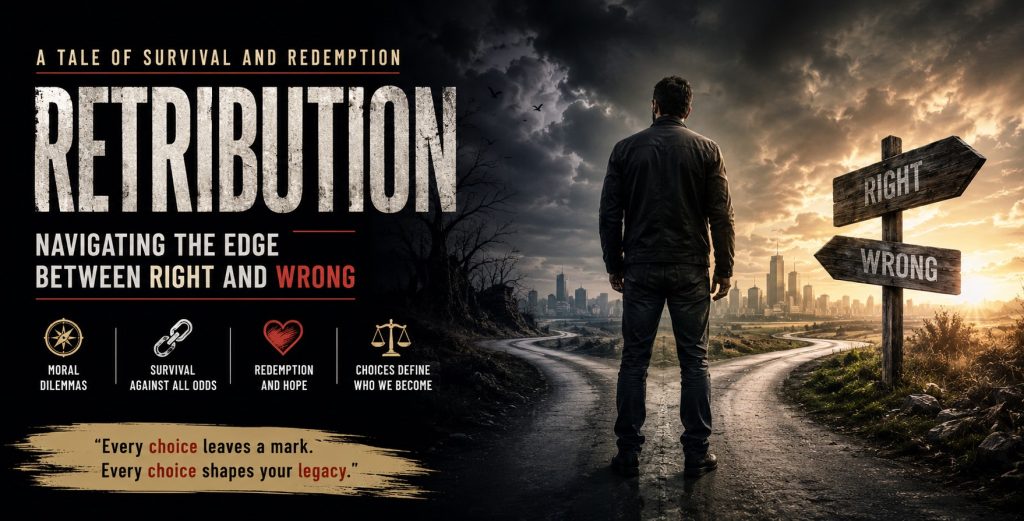
Every day, no matter where we live or what we do, we face moral dilemmas. Some are small and almost imperceptible; others stop us in our tracks and make us question what we believe. Everyday moral dilemmas may seem simple at first, but their resolution shapes our character and how we participate in society.
Redemption Amidst Shadows: The Journey of the Protagonist
Retribution: A Tale of Survival and Redemption byMichael Papadopoullos is a story about a man who, after being kidnapped and manipulated into becoming an assassin, manages to escape his captors. As he attempts to rebuild his life, he confronts ongoing threats and the consequences of his violent past. Despite the constant presence of danger and moral dilemmas, he strives for forgiveness and a new beginning, questioning whether he can truly escape his former life and find peace.
Retribution: A Tale of Survival and Redemption helps you navigate them as best as possible and reconnect with yourself.
Haunted by the Past: Facing Trauma in Retribution
There are “difficult” times when things happen around us or within us that challenge us. For example, losing a loved one, going through an illness of our own or a family member’s, moving to a new city or changing jobs, experiencing political and social events, or being in the midst of natural disasters.
In these moments, the main recommendation is to focus on feeling your emotions moment by moment, to open yourself to constant change, not to neglect your physical needs, and to try to maintain the right perspective on what is happening. This will help you avoid amplifying your emotions with misinterpretations.
Riding the Storm: Lessons from Retribution
When I say “going through,” I mean that what we are experiencing is happening through us and is not eternal. Nothing we experience is truly eternal; every emotion and situation is fleeting and transforms into something new. Difficult times pass us by, and sometimes it helps to know that we need to remain calm as they unfold.
Don’t Jump to Shadows: Lesson on Conclusions
Precisely because we are going through a difficult time, it doesn’t help to try to reach conclusions and perfectly understand what is happening. Sometimes the conclusions we reach are distorted by the emotional intensity of what we are experiencing, leading us to incorrect conclusions that make us feel worse. Conclusions like, “I must have done something wrong to deserve this,” “There will be no solution,” “This is going from bad to worse,” “Something bad is happening,” etc., etc. It’s simply a matter of understanding that when you are in the midst of an emotionally challenging situation, it’s best to avoid thinking, as we might be thinking incorrectly.
However, if you suddenly have a breakthrough or insights that make you feel more at peace or positive, then pay attention to them.
Embracing the Moment
We think it’s best to focus on feeling and experiencing what we are experiencing. Allowing the pain if it’s there, allowing the fear if it’s there too. Giving space to these emotions without adding thought, so they can be as genuine as possible. And then, we ask ourselves if there’s anything we can do to improve the situation.
Moral Crossroads: The Heart of Retribution’s Conflict
A moral dilemma arises when we have to choose among two or more options, none of which seems entirely right or easy. They emerge in situations where our values and beliefs conflict.
A moral dilemma confronts us with the question: What is the right thing to do now?
For example, we might see someone drop their wallet and be tempted to ignore it because we’re in a hurry, or return it even though it might delay us. It can also involve more complex situations, such as remaining silent in the face of workplace injustice or accepting the consequences of speaking out.
Choosing is never neutral: every decision leaves a mark.
The Dilemmas of Retribution: Common Moral Choices Faced by the Protagonist
- Conflicts between our own good and the good of others.
Differences between what we believe is right and what society expects of us. - Doubts about whether to act with sincerity or avoid hurting others.
- Decisions between obeying rules and following our conscience.
Sometimes, confusion doesn’t arise because we don’t know what to do, but because we aren’t even aware that a moral dilemma exists. Based on our observations while working in human development processes, we can identify these situations when:
- We feel discomfort or inner unease.
- No option fully convinces us.
- Making a decision involves sacrificing someone or something we value.
We ask ourselves: ‘Am I acting out of fear or integrity?’
A world novelseness of the dilemma is the first step toward addressing it clearly.
Finding the Path: Resolving Dilemmas Like a Retribution Survivor
Resolving a moral dilemma doesn’t simply mean choosing what’s most convenient for us or mechanically following the rules. Our experience shows that the process can be more conscious when we consider the following elements:
We identify which of our own values are clashing. Is it honesty versus loyalty? Freedom versus obedience? Naming values helps to understand the root of the conflict.
- Gain Perspective
We ask ourselves: ‘If someone else were in my place, what would they think or do?’ This broadens our perspective and reduces the emotional burden of the moment.
- Evaluate The Consequences
We analyze the effects each option would have, not only on ourselves but also on those around us. Visualizing the impact of our actions helps us make more mature and responsible decisions.
- Choose Honestly And Take Responsibility.
After considering all factors, we make a decision aligned with our values and our best intentions. It is key to accept that, sometimes, there is no perfect answer. It is up to us to take responsibility for our decisions, to learn from them, and, if necessary, to make amends.
The Final Reckoning: Retribution’s Moral Legacy
In Retribution: A Tale of Survival and Redemption, moral dilemmas remind us that ethics is not just an intellectual exercise, but a lived experience that plays out in our daily decisions. The more aware we are of our values and the consequences of our actions, the more we can act in accordance with the person we want to become.